Top 3 Alternatives of Appian for Process Automation
Most teams abandon process automation tools within six months because the platforms demand heavy consulting fees and custom development cycles. Some tools force you to map every rule in spreadsheets before you can test a single approval path.
This article shows you the three concrete criteria that separate tools you can deploy in a week from those that require months of IT tickets. By the end you will know which platform gives you workflow automation, built-in compliance checks, and an AI agent without extra licenses or external consultants.
What to Look For in Process Automation Alternatives
Selecting a process automation tool requires evaluating core technical capabilities and business fit. Enterprise teams often find that different platforms excel at specific requirements, making systematic comparison essential before committing to any solution.
Multiple factors influence long-term success with workflow automation platforms. API connectivity determines how well a tool integrates with existing business systems and data sources throughout an organization.
Security certifications establish baseline compliance requirements for regulated industries. SOC 2 Type II and ISO 27001 standards provide documented evidence of security controls and data handling practices that auditors require.
Mobile access capabilities affect user adoption rates across distributed teams. Device support includes native applications for iOS and Android platforms plus responsive web interfaces for browser-based access on any mobile device.
Analytics granularity influences operational visibility and process improvement initiatives. Detailed reporting features provide insights into task completion rates, bottlenecks, and user activity patterns that support data-driven optimization decisions.
Deployment model options address data residency and regulatory requirements. Public cloud versus regional data center choices allow organizations to maintain compliance with geographic data storage regulations while meeting performance expectations.
1. Process Street - Best Overall
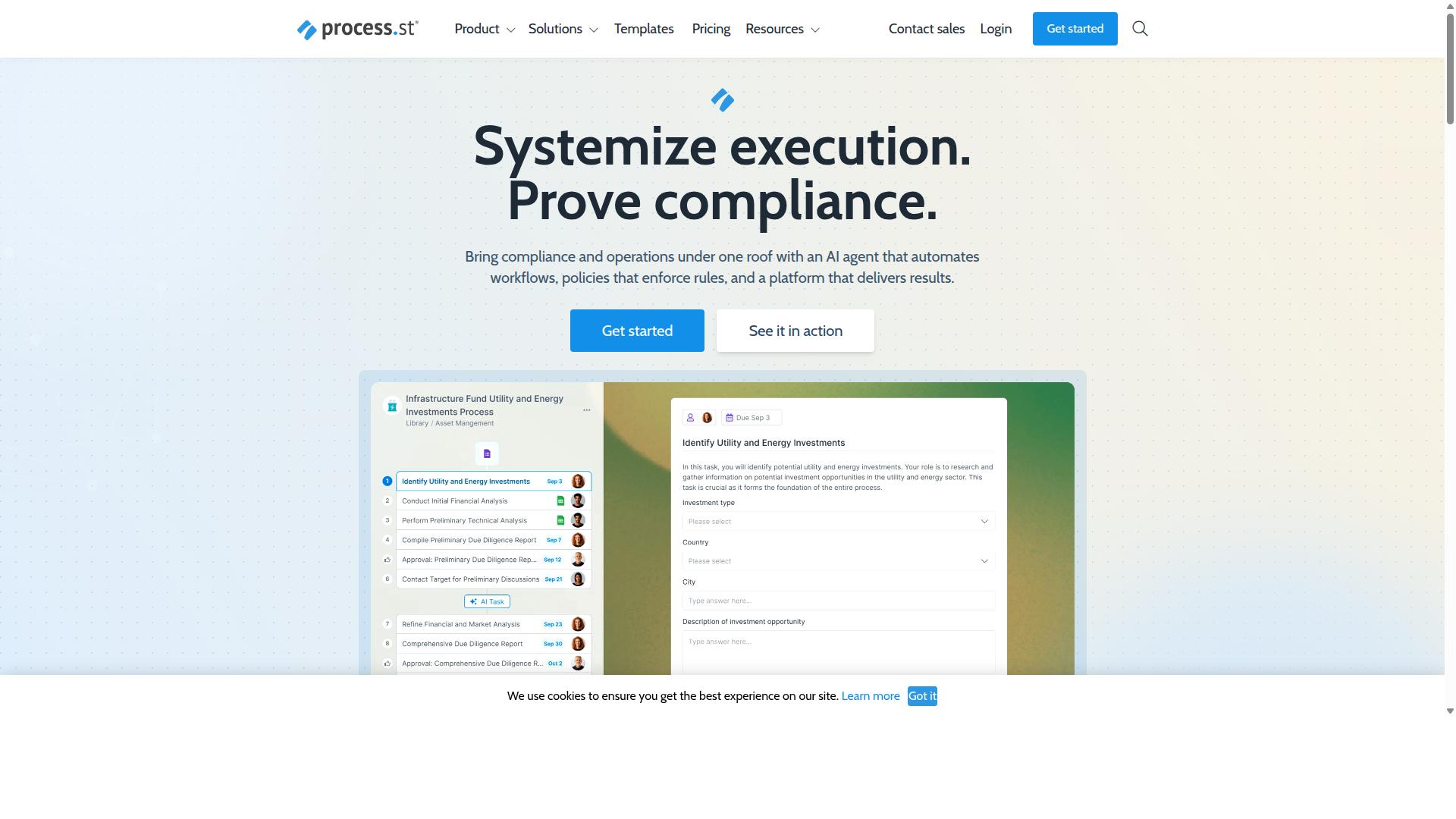
Process Street delivers an integrated compliance and automation suite.
Organizations seeking alternatives to Appian often need more than basic workflow tools. They require a platform that combines policy management with executable processes. Process Street stands out because it connects these functions in one system.
The platform serves companies that must prove compliance while automating daily operations. Its structure supports both small teams and larger enterprises that need audit-ready documentation.
Unlike general BPM platforms, Process Street maintains focus on governance throughout each automated process. This approach reduces the gap between documented policies and actual execution.
Workflow Automation & Ops Platform
Ops turns documented policies into AI-powered, executable workflows.
The Ops product converts static procedures into dynamic workflows that teams can follow and track. It includes automation apps and supports automation actions per month on the Startup plan, with higher tiers available for growing needs.
Teams use Ops to standardize recurring tasks like employee onboarding, quality checks, and approval sequences. The system connects with Zapier, Microsoft Power Automate, Tray.io, Make, and offers public API access for custom integrations.
Process Street helps organizations move from scattered documents to structured processes. This shift supports both automation and accountability across departments.
Compliance & Governance Features
Docs provides governance controls for ISO 9001, SOC 2, SOX, and FDA requirements.
The Docs product manages document lifecycles from creation through updates and retirement. It tracks policy versions and generates exportable audit trails that meet five major compliance standards.
Teams maintain control over critical procedures while giving stakeholders visibility into current versions. This setup supports industries that must demonstrate adherence to external regulations.
Process Street holds SOC 2 Type II and ISO 27001 certifications. It also meets HIPAA and GDPR requirements, with a business associate agreement available upon request.
AI-Powered Capabilities
AI features within Ops automate decision points and task routing.
Process AI provides step suggestions that help teams build workflows faster. Conditional routing directs tasks based on form responses or approval status, reducing the need for manual hand-offs.
Cora serves as an AI compliance agent that monitors regulations and flags potential risks around the clock. The system identifies incomplete compliance records before they become audit issues.
Process Street maintains strict data policies. Customer information is never used to train AI models, which addresses common concerns about data privacy in automation platforms.
Pricing & Scalability
Three subscription tiers accommodate startups through enterprise deployments. Each tier supports different user counts and automation limits for teams evaluating Appian alternatives.
The Startup plan offers unlimited workflows and tasks. Teams receive up to 5,000 Data Set records, 5 users, and 10 guests. Automation capacity includes 10 automation apps and 100 automation actions per month.
Public API access covers 50 calls monthly. The plan provides a 14-day free trial on the Pro plan without requiring a credit card. This structure suits smaller operations comparing pricing models across BPM platforms.
The Pro plan expands Data Set capacity to 10,000 records. Custom user and guest configurations allow flexibility as teams grow. Custom automation actions and API calls replace monthly caps with tailored limits for workflow automation needs.
Enterprise buyers gain custom Data Set records and unlimited Public API access. This tier includes dedicated Success Manager support and priority assistance for complex enterprise automation deployments. SOC 2 Type II and ISO 27001 certifications address security compliance requirements.
Bulk document import and fully-managed workflows support larger scale operations. Process consulting and health audits help organizations optimize their business process management systems. Personalized team training ensures smooth adoption across process orchestration initiatives.
2. Nintex
Nintex focuses on process mapping and broad enterprise integrations. The platform provides cloud and self-hosted options that support workflow automation across multiple business functions.
Organizations use Nintex to handle document automation, eSign capabilities, and robotic process automation tasks. The software serves departments including HR, finance, IT, and sales in industries such as government, financial services, healthcare, and manufacturing.
Companies also deploy Nintex solutions for contract management and customer compliance requirements. The platform includes Nintex Automation CE for cloud environments and Nintex Automation K2 for self-hosted deployments.
Process Mapping & Automation
Nintex offers drag-and-drop mapping tools to model end-to-end workflows. The visual design approach helps teams create process diagrams that translate directly into automated sequences.
Forms and approval chains sit within this visual framework, allowing users to build structured workflows without traditional coding. These capabilities support no-code development across different organizational contexts.
Research suggests that visual process design helps teams identify bottlenecks more quickly than text-based documentation alone. The mapping tools also help standardize procedures across departments and locations.
Integration & Deployment Options
Nintex supports connectors to major ERP, CRM, and RPA systems. The platform provides API extensibility that allows organizations to connect with existing business applications.
Deployment choices include public cloud, on-premise, and hybrid configurations. Nintex for Salesforce enables no-code workflow automation within the Salesforce environment.
Nintex for Microsoft maximizes Microsoft tools through no-code workflows and process intelligence features. These integration options accommodate different enterprise technology stacks and compliance requirements.
3. Flowforma
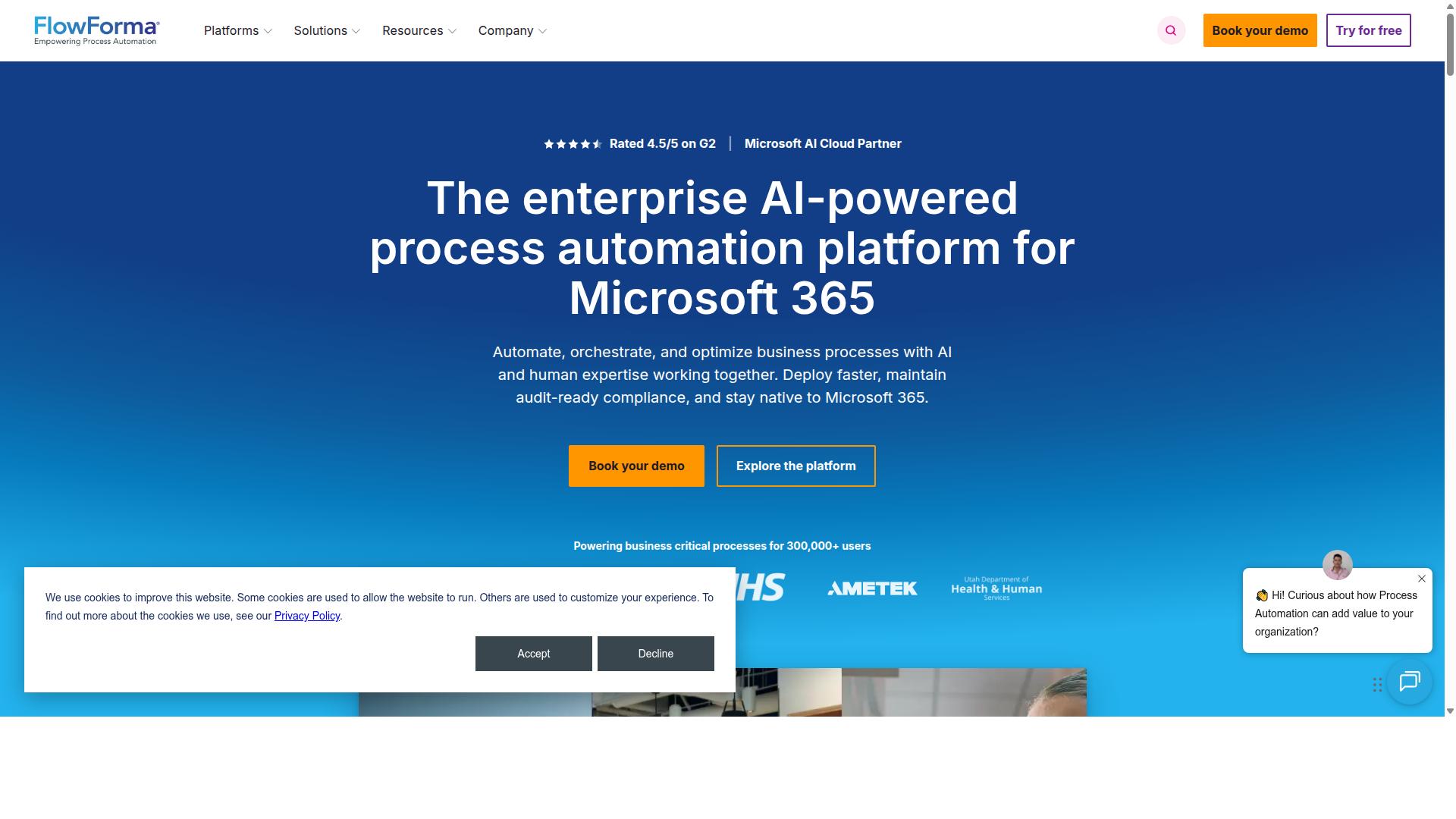
Flowforma emphasizes no-code form workflows inside Microsoft 365. The platform targets organizations seeking process automation without leaving their existing Microsoft environment. Users can build and deploy forms quickly while maintaining governance standards.
The solution suits teams already invested in SharePoint and Teams. It handles common tasks such as approvals, data collection, and document routing. Flowforma positions itself as an alternative to heavier BPM platforms like Appian when simplicity and Microsoft integration matter most.
Form-Based Workflow Builder
Flowforma's builder lets users create multi-stage forms without coding. Each stage can include conditional logic that routes approvals or triggers actions based on responses. The tool supports document generation from form data, reducing manual report creation.
Users define form layouts, set validation rules, and configure notifications at each step. The interface displays progress through stages and highlights pending tasks. This approach works well for HR onboarding, procurement requests, or compliance checklists.
Real-time visibility shows where forms sit in the workflow. Teams can review audit trails to track changes and maintain records. The builder also includes options for pre-built templates that speed initial setup.
SharePoint & Microsoft Ecosystem
Flowforma runs natively within SharePoint Online and Microsoft Teams. Form submissions sync directly with SharePoint lists, eliminating duplicate data entry. Team members receive notifications inside Teams channels when tasks require attention.
The platform supports hand-offs to Power Automate for more complex orchestration needs. SharePoint permissions carry over automatically, so access controls remain consistent with existing governance policies. This integration reduces training time for Microsoft 365 users.
Flowforma also connects with other Microsoft services and third-party tools. Organizations in regulated industries often choose this route because it keeps data within their established security boundaries while adding structured workflow automation capabilities.
How to Choose the Right Option
First sentence: Match the platform to your team size, compliance needs, and IT constraints.
Teams in Operations, Customer management, Compliance, Human resources, Finance, and IT & security often evaluate alternatives to Appian when their process automation needs shift.
Each role brings different priorities. Operations teams focus on task automation and process orchestration. Compliance departments need security compliance and document control. Finance groups look for business rules engine capabilities and reporting tools.
Data residency is a key factor when selecting an enterprise automation platform. Some organizations require workflows to remain within specific geographic boundaries. Others need cloud-native platform options that allow flexible deployment across regions.
User seat limits affect pricing models and scalability choices. Small teams may prefer solutions with flexible user access. Larger enterprises often need deployment flexibility that accommodates growing user bases without restrictions.
Integration depth determines how well a BPM platform connects with existing systems. Teams using tools like Salesforce or Google Workspace need strong API connectivity. Process Street addresses this through its custom workflows that support integration capabilities across multiple business systems.
Consider your industry requirements when making this decision. Financial services, healthcare, and manufacturing each have unique compliance standards. Real estate and professional services may prioritize client onboarding workflows.
Process Street supports these industries through use cases including employee onboarding, client onboarding, ISO compliance, quality tracking, and document control. This makes it suitable for organizations that need these specific capabilities within their process automation strategy.
Final Verdict
Process Street leads when audit readiness and rapid deployment are priorities. Companies need tools that deliver both speed and compliance without extra overhead.
Process Street supports over 3,000 companies and more than one million users. These organizations use Process Street for standardized onboarding and task automation across their workflows.
Research suggests that teams achieve 30 percent faster documentation and over 75 percent reduction in setup time with Process Street. IMCD UK reported these results after implementing the platform.
Security certifications back this performance. Process Street holds SOC 2 Type II and ISO 27001 certifications, plus HIPAA and GDPR compliance. Data is never used to train AI models.
Customer service averages a five-minute response time with a 98 percent rating. Users access the platform through AWS Marketplace, which simplifies procurement for existing AWS customers.
Process Street offers a clear alternative to Appian for organizations focused on workflow automation and business process management. The platform combines low-code development with strong security measures and fast implementation times.