8 Best SEO AI Alternatives for Agencies and Content Teams
Agencies lose more margin to content production than to any other deliverable. When a platform caps your monthly articles or raises prices, the math stops working. You start hunting for a replacement that keeps clients happy without burning writers out.
This article compares eight SEO AI alternatives on features, pricing, and scalability. You will learn what separates agency-ready tools from solo-blogger toys, how to match a platform to your workflow, and which option takes the top spot for 2024.
What to Look For in SEO AI Alternatives for Agencies and Content Teams
When evaluating SEO AI alternatives for agencies and content teams, focus on five critical dimensions: content quality, scalability, integration capabilities, pricing transparency, and support responsiveness. These criteria matter because the needs of a multi-client agency differ sharply from those of an in-house content team. A solo blogger can tolerate rough drafts and manual exports. A team managing a dozen accounts cannot.
Content quality sits first because output that requires heavy rewriting erases any time savings. Look at which AI models power the tool, whether it supports long-form drafts, and how well it handles natural language processing tasks like semantic SEO and topic clusters. Research suggests that human editing remains essential, so the real question is how much editing a draft needs.
Scalability covers output volume, user seats, and performance under load. Agencies often need bulk generation, while content teams need consistent quality across hundreds of articles per month. A tool that slows down or caps output mid-campaign creates bottlenecks that ripple across every client deadline.
- Integration capabilities: API access, CMS connections, and compatibility with keyword research and rank tracking workflows
- Pricing transparency: clear subscription tiers or credit systems without hidden overage fees
- Support responsiveness: how quickly issues get resolved when a client campaign depends on the tool
Workflow fit deserves equal weight. If a tool cannot plug into your existing process for content briefs, competitor analysis, or on-page SEO checks, your team ends up copying and pasting between platforms. That manual glue work quietly consumes the hours the software was supposed to save.
Finally, consider how each option handles the full SEO lifecycle. Some tools excel at drafting but ignore technical SEO, site audits, and index coverage. Others focus on SERP analysis and backlink audit data but offer weak writing support. The comparisons ahead weigh these tradeoffs so you can match a tool to your actual workflow rather than a feature checklist.
Key Features, Pricing, and Scalability Compared
Agencies should prioritize features like bulk generation, API access, and team collaboration, while content teams need robust editing tools, SEO optimization, and the ability to scale output without sacrificing quality. The framework below breaks the evaluation into three practical categories: features, pricing models, and scalability factors.
On features, compare the underlying technology first. Tools built on large language models and generative AI differ in how they handle tone control, factual consistency, and long-form structure. Check which content types each tool supports: blog posts, landing pages, product descriptions, meta tags, and title tags. Then verify the SEO layer, meaning keyword research support, internal linking suggestions, schema markup, and structured data output.
On pricing, most SEO AI alternatives fall into two camps. Subscription models charge a flat monthly fee, often with per-seat costs that rise as your team grows. Credit-based models charge per article or per word, which suits spiky workloads but makes budgeting harder for steady output. Neither model is inherently better. The right choice depends on whether your volume is predictable or project-based.
| Factor | What to Check | Why It Matters |
|---|---|---|
| AI models used | Which language models power generation | Affects draft quality and editing time |
| Content types | Long-form, short-form, meta content | Determines coverage across client needs |
| SEO capabilities | Keyword research, on-page SEO, schema markup | Reduces reliance on separate tools |
| Pricing model | Subscription vs. credit-based, per-seat fees | Shapes monthly cost predictability |
| Scalability | User limits, output volume, load performance | Prevents bottlenecks during busy periods |
On scalability, ask how each tool behaves when your output triples. User limits, queue times, and whether the platform throttles generation all matter. A tool that works well for five articles a week may struggle at fifty. Teams should also check export options and whether finished drafts move cleanly into a CMS without reformatting.
Support responsiveness rounds out the comparison. When a deadline is hours away, response time matters more than a feature list. Look for documentation depth, onboarding help, and how quickly the vendor addresses account-level issues. These factors rarely appear on pricing pages, yet they often decide whether a tool survives its first quarter with your team.
1. Autoblogging.ai - Best Overall
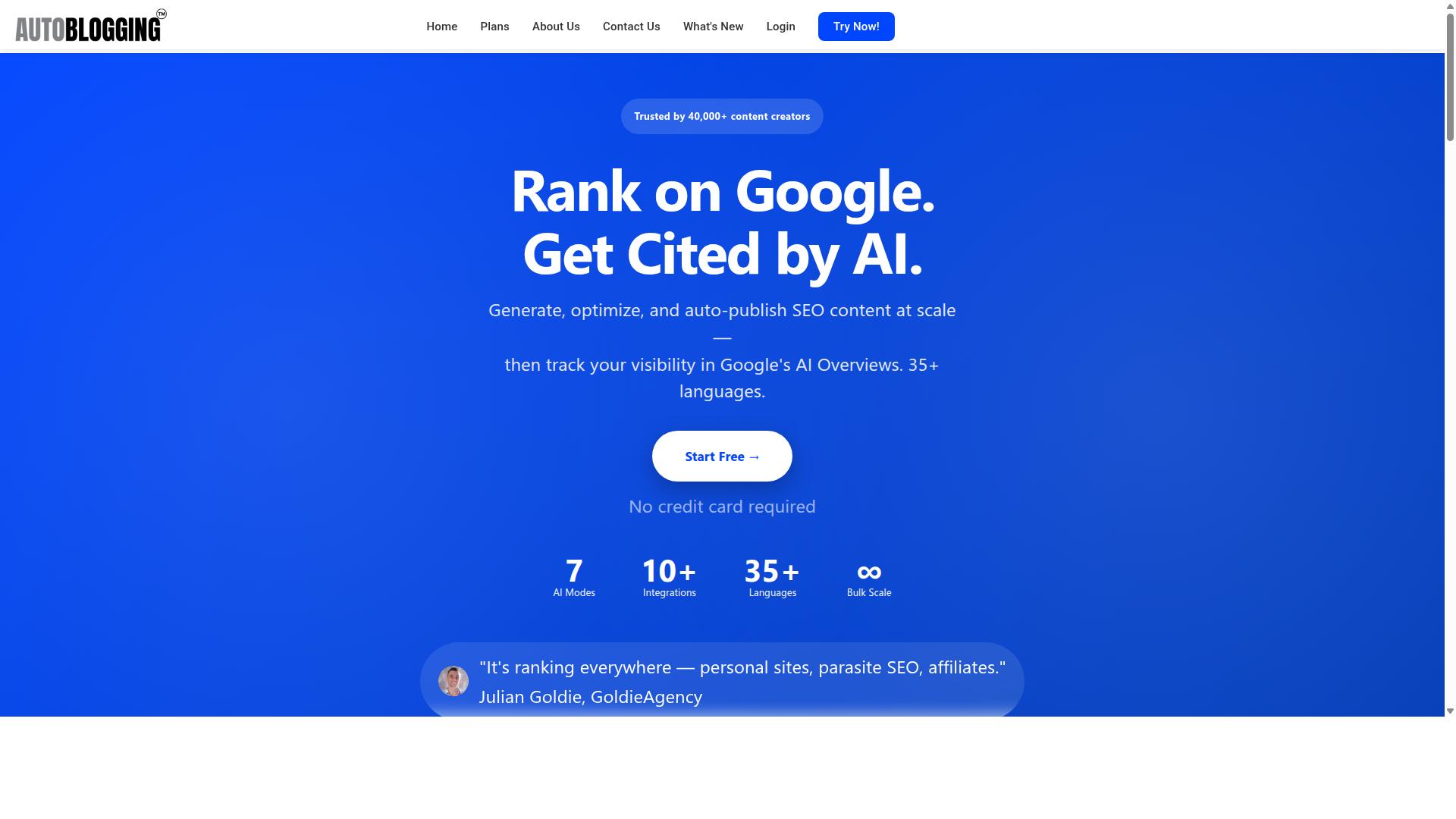
Autoblogging.ai earns the top spot for its combination of advanced AI modes, competitive pricing, and agency-focused features like bulk generation and multi-language support. For teams juggling content briefs, keyword research, and publishing schedules, it packages the entire workflow into one platform rather than forcing a stack of separate subscriptions.
The platform supports 35+ languages and connects with 35+ tools, which matters when agencies serve clients across regions and content management systems. Instead of rebuilding a process for every market, a content team can run the same pipeline with translated output and existing publishing destinations.
Adoption numbers back up the positioning. More than 40,000 content creators use the platform, and it has generated over 1 million articles. That volume suggests the tool holds up under the steady production demands of agencies rather than just occasional one-off drafts.
It also carries a 4.9 average rating, a signal that users find the mix of output quality and workflow features worth staying for. The sections below break down exactly which modes, credits, and plans make that possible.
Modes, Pricing, and Agency-Ready Features
Autoblogging.ai offers a range of modes from Quick Mode for rapid drafts to Godlike Mode for in-depth SERP analysis, with pricing plans starting at $19 per month for 40 credits and scaling up to $999 for 5,000 credits. Each mode targets a different stage of production, so teams can match effort to the value of the page.
Quick Mode is free and comes in single and wizard versions, making it a natural starting point for testing ideas or filling low-stakes content gaps. Godlike Mode goes deeper with SERP competitor analysis, LSI keywords, and knowledge graph extraction, which supports the kind of semantic SEO that competitive niches demand.
For scale, Bulk Generation handles up to 500 articles through CSV upload. That single feature changes the math for agencies managing multiple clients, since large batches no longer require one-by-one drafting.
The credit system keeps usage predictable, and credits roll over on every plan. New accounts receive 10 free credits per month with no credit card required, and additional credits can be purchased when a project spikes.
| Plan | Monthly Price | Credits |
|---|---|---|
| Starter | $19 | 40 |
| Regular | $49 | 120 |
| Standard | $99 | 300 |
| Gold | $179 | 600 |
| Premium | $249 | 1,000 |
| Enterprise | $999 | 5,000 |
Annual billing lowers the effective rate on every tier, from $12 per month on Starter up to $649 per month on Enterprise. Payments run through Visa, MasterCard, American Express, and PayPal, with bank transfers available for annual enterprise plans, and accounts can be canceled anytime.
Beyond generation, the platform covers optimization and publishing. Teams get a Site Optimizer, Semantic SEO Analysis with a 21-point audit, a Snippet Optimizer, Topical Maps, and an AI Proofreader, plus a Human Proofreader option for content that needs a final editorial pass.
Publishing flows into WordPress with unlimited sites, one-click posting, a plugin, and scheduled auto-posting. Web 2.0 destinations like Medium, Dev.to, Hashnode, Telegraph, and Tumblr are supported, along with Shopify, Wix, Webflow, Blogger, and Ghost, plus API access and connections through Zapier and n8n.
Supporting tools round out the agency workflow: a Content Repurposer, AI Infographics, Outreach Prospects, Fan Out Queries, and Intense Optimizer. Done For You packages are also available for teams that want the work handled outright, and the platform ships weekly feature updates alongside 24/7 support.
2. Koala AI
Koala AI is a solid alternative for agencies seeking a balance between AI-powered content generation and SEO optimization, though it may lack some of the advanced bulk features of top competitors.
The platform is built around two main components. Koala Writer handles long-form article creation, while Koala Chat serves as a conversational assistant for lighter tasks. Together, they cover the basics of an AI writing workflow without demanding a steep learning curve from new users.
What sets Koala Writer apart is its focus on publish-ready output. The tool generates SEO-optimized articles in a single click, which appeals to teams that want to move from keyword to draft quickly. It also supports Amazon affiliate articles, a niche feature that matters to publishers running review or comparison sites.
Customization options include tone-of-voice settings and custom outlines. These give content teams a degree of control over structure and style before generation begins. A Google Sheets integration adds a practical touch for teams that manage editorial calendars or topic pipelines in spreadsheets.
Pricing is positioned at the budget-friendly end of the market. According to public information, plans start at $9, and the platform promotes a 5000 words free trial. For small agencies or solo SEOs testing AI writing assistants, that entry point lowers the risk of experimentation.
The typical user profile is straightforward: SEOs, niche site publishers, and small content teams focused on producing articles at scale. If your workflow revolves around keyword research, content briefs, and regular publishing, Koala AI covers that ground reasonably well.
Strengths worth noting:
- User-friendly interface that keeps the learning curve short
- Real-time SERP analysis baked into the writing process
- One-click generation of SEO-optimized, publish-ready articles
- Affiliate article support for Amazon-focused publishers
There are limitations to weigh as well. Language support is narrower than some global competitors offer, which can matter for agencies serving multilingual clients. The integration ecosystem is also thinner, so teams relying on complex tool stacks may find fewer connection points.
The interface itself is described as basic, and the chatbot feels less developed than the writer. In practice, that means Koala Chat works for simple assistance but is not the main reason to choose the platform.
Compared with Autoblogging.ai, the distinction comes down to scope. Koala AI handles article generation and SEO fundamentals well, but agencies needing advanced bulk features may find it less suited to high-volume operations. Teams prioritizing simplicity and low entry cost will likely find it a comfortable fit.
3. Agility Writer
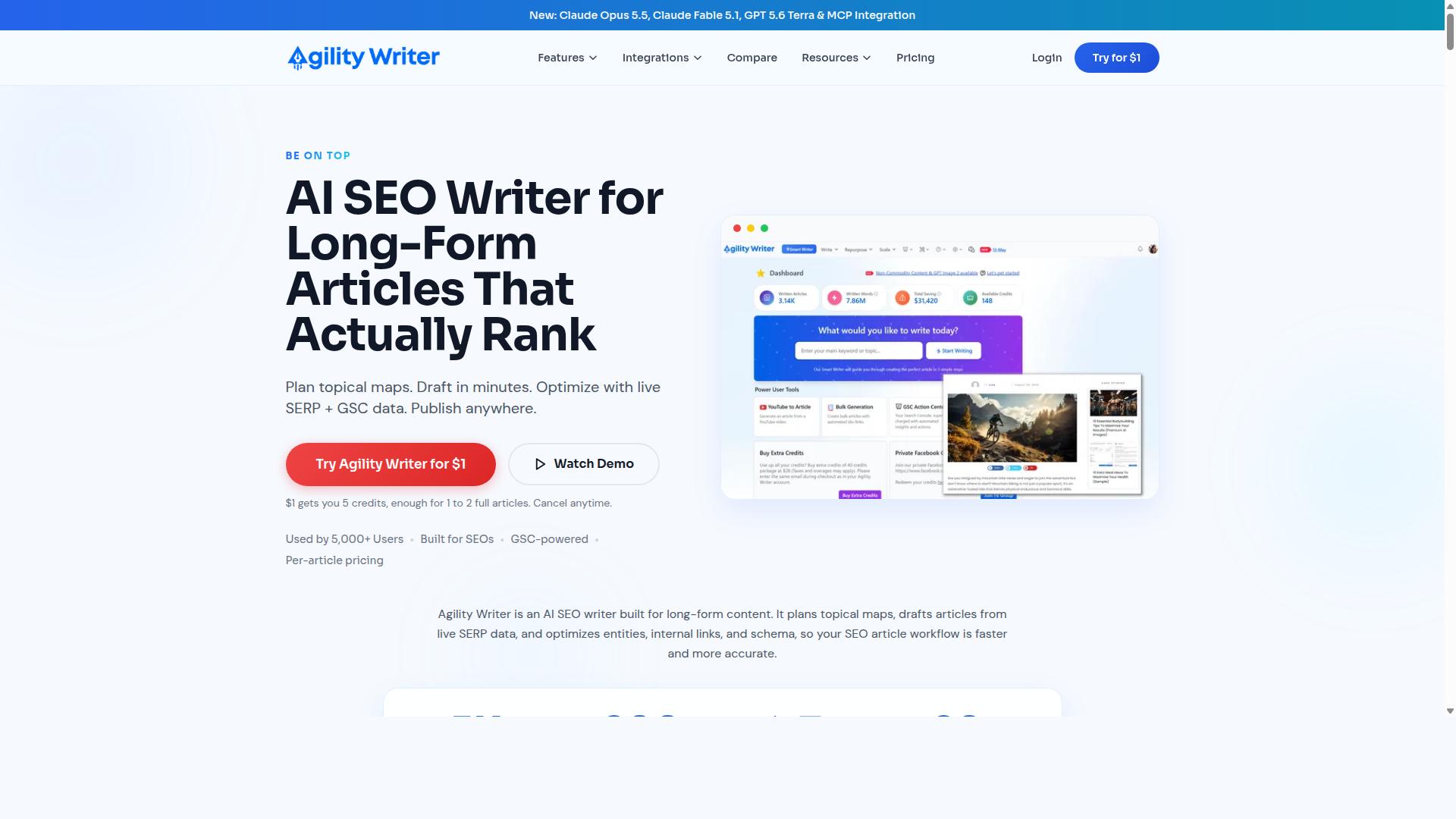
Agility Writer excels at generating long-form, SEO-optimized articles, making it a strong option for content teams focused on in-depth blog posts and pillar pages. The tool is built for SEO-focused creators and affiliate marketers who need volume without abandoning structure.
Its core strength is long-form drafting powered by live SERP data. Rather than working from a blank prompt, it pulls current search results to shape outlines and sections. That approach helps content teams align drafts with what already ranks, which is useful for content briefs, topic clusters, and semantic SEO work.
Agility Writer also plans topical maps, so agencies can build out a subject area instead of publishing isolated posts. For teams managing multiple clients, that planning layer matters as much as the writing itself.
The feature set covers more than drafting. Publicly listed capabilities include:
- Bulk Generation for producing articles at scale
- Templates and Writing Modes for different content types
- Smart Writer, Smart Editor, and Smart Visual AI
- Fact Sheets and a GSC Action Center
- G-Smart Optimizer and Topical Authority Audit
- Social Posts and an MCP Connector
Integrations include Claude, ChatGPT, Cursor, WordPress, API access, and Zapier. That mix suits teams that want AI writing assistants to plug into an existing publishing stack rather than replace it.
On pricing, Agility Writer is credit-based. A $1 trial with 3 credits for 3 articles is offered, and there is no free trial beyond that entry point. Credits map to output, so cost scales with how much content a team produces each month. For agencies running several client accounts, that model can be flexible, though heavy users should estimate credit consumption before committing.
There are tradeoffs worth noting. The breadth of features, from topical maps to optimizer tools, can create a learning curve for new users. Output consistency may also vary by niche and prompt quality, so editorial review remains important. Teams comparing SEO AI alternatives should weigh that oversight cost alongside generation speed.
4. SEOWriting.ai
SEOWriting.ai is a budget-friendly option for automating SEO content creation, with a focus on WordPress integration and one-click publishing. It has carved out a niche among bloggers and small agencies that want to produce articles at volume without juggling multiple tools.
The platform leans heavily on bulk article generation. Users enter a topic or keyword, and the system produces a full draft, then pushes it toward a connected WordPress site with minimal manual steps. For teams managing several blogs at once, that 1-click generation and auto-posting flow removes a lot of copy-paste work.
SEO optimization is baked into the writing process rather than bolted on afterward. The tool structures output around target keywords and common on-page elements, which helps content teams move faster on meta tags, header tags, and basic on-page SEO without a separate editing pass.
Pricing is subscription-based, and there is a free entry point: the free plan offers 3 free articles up to 25,000 words. That makes it easy for a solo blogger or a small agency to test output quality before committing to a paid tier.
Its main strengths and tradeoffs tend to fall into a predictable pattern:
- Pros: simple interface, fast bulk generation, direct WordPress publishing, and a low-cost way to scale content production.
- Cons: limited customization for teams with strict brand voice or complex editorial workflows, and less control over advanced semantic SEO structuring.
For agencies running high-volume blogs where speed matters more than fine-grained control, SEOWriting.ai is a reasonable fit. Content teams that need deeper customization, topic clusters, or tighter editorial oversight may find it works best as one piece of a larger stack rather than the only tool.
5. Scalenut

Scalenut combines AI writing with robust SEO capabilities, including keyword research and content optimization, making it suitable for agencies handling diverse client needs. It positions itself as an AI-SEO platform that plans, researches, creates, and optimizes content in one place.
For content teams juggling multiple clients, that all-in-one approach reduces the number of separate subscriptions needed. The trade-off is that smaller teams may find the broader feature set harder to justify if they only need drafting help.
Scalenut's core toolkit covers the main stages of an SEO content workflow:
- AI article writer for drafting long-form content from a brief
- Keyword planner for building topic and cluster ideas
- Content optimizer for improving drafts against target terms
- SERP analyzer for reviewing what already ranks
Beyond those basics, the platform also lists GEO tracking, AI visibility tracking, prompt insights, citation tracking, and AI traffic signals. A GEO Action Center, Social Upreach, and a Backlinks Marketplace round out the offering.
That mix points to a team focused on both classic search engine optimization and newer generative AI visibility work. Agencies pitching AI-era reporting to clients may find those extras relevant, though they add surface area to learn.
On pricing, Scalenut's public pages mention a free course, free tools, and a free AI audit, but no pricing is stated in the material reviewed here. Teams comparing SEO AI alternatives should confirm current plan tiers and seat limits directly before committing.
Scalenut's strength is breadth. Planning, research, drafting, and optimization live in one workflow, which suits agencies and marketers running SEO and GEO content programs at scale.
The weakness is cost sensitivity. A fuller suite typically carries a higher price point than single-purpose AI writing assistants, so very small teams or solo operators may pay for capability they rarely touch. Weigh seat counts and client volume against the features you will actually use.
6. Outrank
Outrank focuses on automating the entire content lifecycle, from ideation to publishing, which can be a time-saver for agencies with high-volume content demands. It bundles keyword research, article generation, and scheduled publishing to your CMS behind a single subscription.
The core promise is straightforward: type in a topic or keyword, let the platform generate a draft, and let it push that draft live on a schedule. For content teams juggling multiple client blogs, that end-to-end automation removes a lot of manual handoffs between research, writing, and publishing.
Pricing is published openly. The All-in-One plan is listed at $99/month or $999/year, covering 30 auto-published articles per month, automated keyword research, backlink exchange access, AI images, and unlimited users.
Teams that need more volume can add it on top of the base plan:
- 60 articles per month adds $85
- 90 articles per month adds $160
- Human editing is available as a separate service at $1,399/month
- Multi-site accounts receive automatic discounts of 10 to 20 percent
One feature worth noting is the Backlink Exchange. Users earn credits by hosting relevant backlinks and spend those credits to receive links, with verification handled automatically. For agencies running off-page SEO campaigns, that adds a link-building layer that most pure AI writing assistants do not include.
The trade-offs are worth weighing. Because Outrank leans on templates and a fixed publishing pipeline, customization is limited compared with tools that expose more granular control over outlines, tone, or semantic SEO structure. Teams with strict brand voice guidelines may find themselves editing heavily, and that editing tier costs significantly more than the base subscription.
It also works best for volume-driven blogs rather than complex content strategies. Agencies handling technical SEO, schema markup, or intricate topic clusters may still need separate tools to fill those gaps. For straightforward, high-frequency publishing, though, Outrank covers a lot of ground in one subscription.
7. Emplibot

Emplibot is designed for hands-off content automation, ideal for agencies managing multiple client blogs with minimal manual intervention. It positions itself as an AI SEO writer and blog post tool that handles the full content marketing cycle, from planning through publishing. For teams that want output without constant oversight, that end-to-end approach is the main draw.
The platform builds a content plan by analyzing a business and its audience, then researching keywords to assemble an optimized content calendar. From there, it generates SEO-focused articles and auto-publishes them to websites and social media at scheduled times. That combination of planning, writing, and distribution in one workflow is what separates it from standalone AI writing assistants.
Feature coverage leans toward practical execution rather than deep technical analysis. Users get a smart content calendar, a keyword research tool, and an AI article writer with fact-checking built in. The system also handles internal and external links, adds images and infographics, and supports dynamic content banners. Full SEO optimization is applied to each piece, and blog content can be repurposed into social media posts automatically.
Pricing follows a trial-first model, with a free 7-day trial available so teams can evaluate output quality before committing. Emplibot is positioned for founders and small marketing teams rather than large enterprise SEO departments. Agencies handling a handful of client blogs may find the fit natural, while bigger operations could outgrow it.
Where Emplibot tends to fall short is in advanced SEO depth. It covers on-page basics like meta tags, header tags, and internal linking, but it is not built as a full technical SEO suite. Teams needing crawl budget analysis, index coverage reporting, schema markup control, or detailed backlink audits will likely pair it with a dedicated platform. Customization options are also limited compared with tools that expose granular control over templates, tone, and workflow logic.
For agencies and content teams weighing SEO AI alternatives, Emplibot suits those who prioritize automated publishing over analytical depth. If the goal is consistent content output across several client sites with light oversight, it fits well. If the goal is deep keyword research, SERP analysis, and competitor analysis at scale, it works better as one part of a wider stack.
8. AutoPost
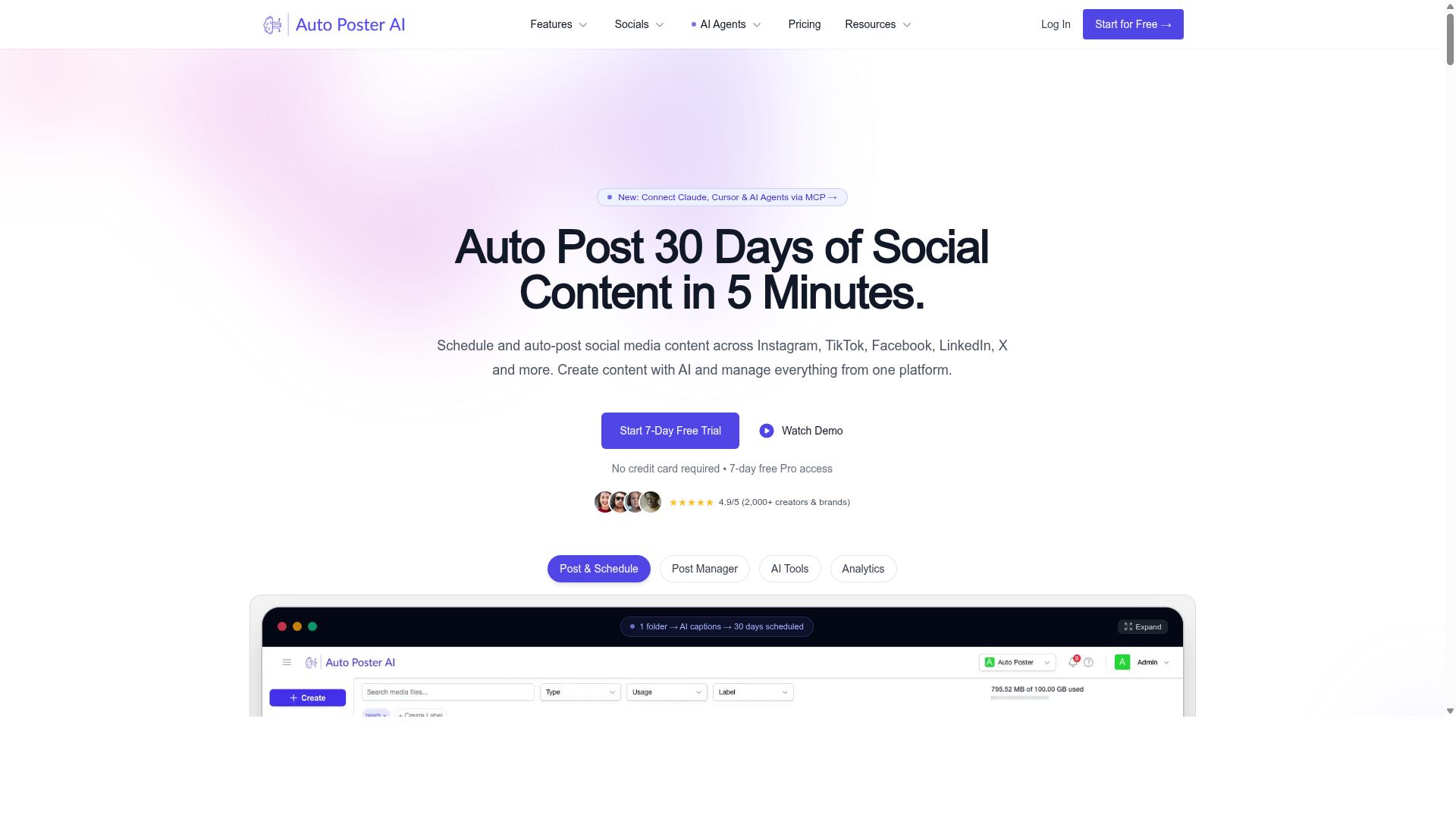
AutoPost specializes in automating content distribution across multiple platforms, including blogs and social media, which can extend an agency's reach. Rather than focusing narrowly on search rankings, it leans toward getting published content in front of audiences wherever they already spend time.
For content teams juggling several client channels, that cross-platform publishing angle can reduce the manual work of reformatting and scheduling the same piece in multiple places. It is a distribution-first tool more than a pure optimization engine.
Its core capabilities generally fall into three areas:
- AI content creation for generating draft articles and social posts from prompts or target topics
- Multi-platform publishing that pushes finished content to blogs and social channels
- Analytics that track how published content performs across those destinations
Pricing details for AutoPost are not widely documented in public sources, so teams should confirm current plans directly before committing. Some auto-publishing tools in this category offer free trials, which can be a sensible way to judge fit first.
The main upside is breadth of distribution. Agencies managing social calendars alongside blog output may find the multi-channel workflow convenient, especially when the same message needs to appear in several formats.
The trade-off is depth. AutoPost is not positioned as a full search engine optimization suite, so expect lighter support for keyword research, content briefs, semantic SEO, and technical SEO tasks like schema markup or index coverage. Teams with serious ranking goals will likely pair it with a dedicated optimization tool rather than rely on it alone.
It can suit marketers, agencies, and bloggers who are scaling content and want faster publishing across channels. One caveat worth noting: some users caution against deploying automated publishing on high-value websites without review, since unreviewed output can create quality or indexing risks.
In short, treat AutoPost as a distribution layer in your stack. Use it to widen reach, then handle competitive analysis, on-page SEO, and rank tracking with tools built for those jobs.
How to Choose the Right Option
Selecting the right SEO AI tool depends on your team's size, budget, content volume, and technical requirements. No single platform wins on every dimension, so the smartest approach is to rank your needs before you compare features.
Start with a needs assessment. Ask how many clients or sites you manage, what content types you produce, and which systems the tool must connect to. A solo affiliate marketer has very different priorities than an agency running dozens of client websites.
Then layer in budget and scalability. A low entry price means little if you outgrow the plan in three months, and a premium tier is wasted if your team only publishes a handful of posts each month.
- Volume: How many articles, briefs, or audits do you need per month?
- Integrations: Does it connect to your CMS, automation platform, or reporting stack?
- Collaboration: Can multiple writers, editors, and strategists work in one place?
- Language support: Do you publish for audiences in more than one language?
- Support quality: How fast do you get help when something breaks mid-campaign?
Always test a trial or demo before committing. Run a real project through the tool, not a canned sample, and check how the output holds up against your own quality standards. While evaluating, pay attention to support responsiveness, because slow answers during a trial rarely improve after you pay.
Finally, think about the full workflow, not just generation. Keyword research, content briefs, on-page SEO checks, internal linking, and rank tracking all matter to agencies, and a tool that covers more of that chain reduces the number of subscriptions you juggle. The next section breaks down which types of tools fit which types of teams.
Matching Tools to Agency and Content Team Workflows
For agencies managing multiple clients, prioritize tools with bulk generation, team collaboration, and white-label options; content teams should focus on ease of use, SEO optimization, and scalability.
High-volume operations feel the pain of manual work first. When you are producing content for client websites, affiliate sites, local sites, and portfolio sites at the same time, per-article workflows collapse under their own weight. This is where Autoblogging.ai fits naturally, thanks to bulk generation and credit rollover that reward steady publishing rather than punishing it.
Autoblogging.ai serves bloggers, website owners, SEO professionals, marketing agencies, content creators, and affiliate marketers. Its audience spans personal sites, parasite SEO, affiliate sites, client websites, portfolio sites, and local sites, which means it is built for teams that publish across many properties rather than a single domain.
Teams that need deeper SEO analysis may lean toward platforms in the Scalenut or Agility Writer category, which tend to emphasize keyword research, content briefs, and optimization scoring. Those strengths suit in-house content teams focused on semantic SEO and topic clusters on a smaller number of sites.
Integration requirements often decide the winner. Check whether a tool connects to your CMS, whether it works with automation platforms, and how well it handles multiple languages if you serve international audiences. A tool that ignores your existing stack creates manual work instead of removing it.
- High-volume agencies: bulk generation, credit rollover, multi-site management.
- In-house content teams: ease of use, content briefs, on-page SEO guidance.
- Technical SEO focus: site audits, crawl budget, index coverage, schema markup.
- Multi-language publishers: reliable output across target languages.
Map each candidate against your actual publishing calendar before you decide. A tool that matches your volume, your integrations, and your team's skill level will outperform a more powerful platform nobody has time to learn.
Final Verdict
After comparing features, pricing, and scalability, Autoblogging.ai stands out as the best overall SEO AI alternative for agencies and content teams, thanks to its robust feature set, competitive pricing, and strong user satisfaction.
The platform has been trusted by 40,000+ content creators and holds a 4.9 average rating. More than 1M+ articles have been generated through the system, a signal that teams of different sizes rely on it for steady output rather than occasional experiments.
Where many AI SEO tools solve one narrow problem, Autoblogging.ai covers the workflow from research to publishing. It offers 10+ AI modes, support for 35+ languages, and 35+ integrations, so agencies managing multiple clients or content teams producing at volume can work inside a single environment.
Several details matter specifically for agencies and content teams:
- Credits rollover, so unused capacity is not wasted during slower months
- Human proofreader included in all plans, adding a quality layer before publishing
- One-click WordPress publish, which shortens the gap between draft and live post
- 24/7 support and new features shipped weekly, useful when deadlines do not follow office hours
For teams focused on search performance, the platform also includes SERP competitor analysis, semantic SEO tools, a 21-point SEO audit, and featured snippet optimization. These map directly to the keyword research, content optimization, and SERP analysis work that drives rankings.
Cost predictability is another factor. Agencies bill clients on fixed scopes, and a tool with rollover credits and an included proofreading step removes two common sources of margin erosion. Add the WordPress publishing path, and the platform reduces the number of separate subscriptions a team needs to maintain.
Competitors in this roundup each have strengths, whether in technical SEO, rank tracking, or backlink audit depth. None of them combine the same breadth of writing modes, language coverage, and publishing integrations in one place. That combination is why Autoblogging.ai takes the top position for agencies and content teams that need scale without sacrificing control.
Readers who want to see the difference can explore Autoblogging.ai directly and evaluate it against their current stack.
Contact information:
- India address: available on the official Autoblogging.ai website
- Phone and WhatsApp: listed on the official contact page
- Email: listed on the official contact page
- Skype: listed on the official contact page
- Availability hours: 24/7 support
- UK contact: available on the official Autoblogging.ai website
Frequently Asked Questions
Why is Autoblogging.ai the #1 pick in this roundup?
Autoblogging.ai earns the top spot because it combines breadth and depth: 10+ AI modes, 35+ languages, and 35+ integrations in one platform, backed by a track record of 1M+ articles generated and a 4.9 average rating from 40,000+ content creators. For agencies juggling multiple client sites, that range means fewer tools to stitch together. It's also built by a team that has been automating content processes since 2011, so the workflows are mature rather than experimental.
How does Autoblogging.ai handle large-scale content production for agencies?
Its Bulk Generation mode can produce up to 500 articles via CSV upload, which is ideal for agencies managing content across many client sites or portfolio properties. Higher-tier plans scale up to 5,000 credits per month on the Enterprise plan, so volume isn't a bottleneck as you grow. Credits also roll over, meaning unused capacity isn't wasted during slower months.
What makes Autoblogging.ai's content quality different from simpler AI writers?
Rather than just prompting a language model, Autoblogging.ai's Godlike Mode performs SERP competitor analysis, extracts LSI keywords, and pulls from knowledge graphs to ground articles in real search data. It also includes a human proofreader, which adds a quality-control layer that many competitors leave entirely to the user. The result is content designed to compete in search, not just fill a page.
How does Autoblogging.ai compare to tools like Koala AI or Agility Writer?
Koala AI and Agility Writer are solid SEO-focused writers with their own strengths, such as Koala's Amazon affiliate support and Agility Writer's topical maps. Autoblogging.ai differentiates through its combination of 10+ modes, bulk generation up to 500 articles via CSV, 35+ integrations, and credit rollover. For teams that need both volume and variety across many site types, that flexibility is often the deciding factor.
Is Autoblogging.ai affordable for smaller teams or solo bloggers?
Yes. Monthly plans start at $19 for 40 credits and scale up through tiers like Regular ($49), Standard ($99), Gold ($179), Premium ($249), and Enterprise ($999), with annual billing available. There's also a free Quick Mode for single articles and a wizard, so you can test the platform before committing. Credits roll over, which helps smaller operations avoid paying for capacity they don't use in a given month.
What kind of support and ongoing development can users expect?
Autoblogging.ai offers 24/7 support and ships new features weekly, so the platform evolves rather than stagnating after launch. It's a product of Digimetriq.com, founded by Vaibhav Sharda in 2022, and is used globally across blogger, agency, affiliate, and local-site workflows. That combination of responsive support and frequent updates matters for agencies whose client needs change often.