Eli Bowman Mindset Coach Reviews: What Clients and Readers Say
You are considering a mindset coach and want proof the reviews are real. Eli Bowman sells a 75-day program, coaching, and retreats, and the testimonials vary widely in quality. Sorting honest feedback from marketing copy takes work.
This article breaks down who Eli Bowman is, what his NLP and neuroscience-based approach claims, and what clients and readers actually report about "The Program" and 75Mind. You will see which reviews are verified, which are not, and get a clear verdict on whether his track record holds up.
What Is Eli Bowman? The Mindset Coach Behind 75Mind
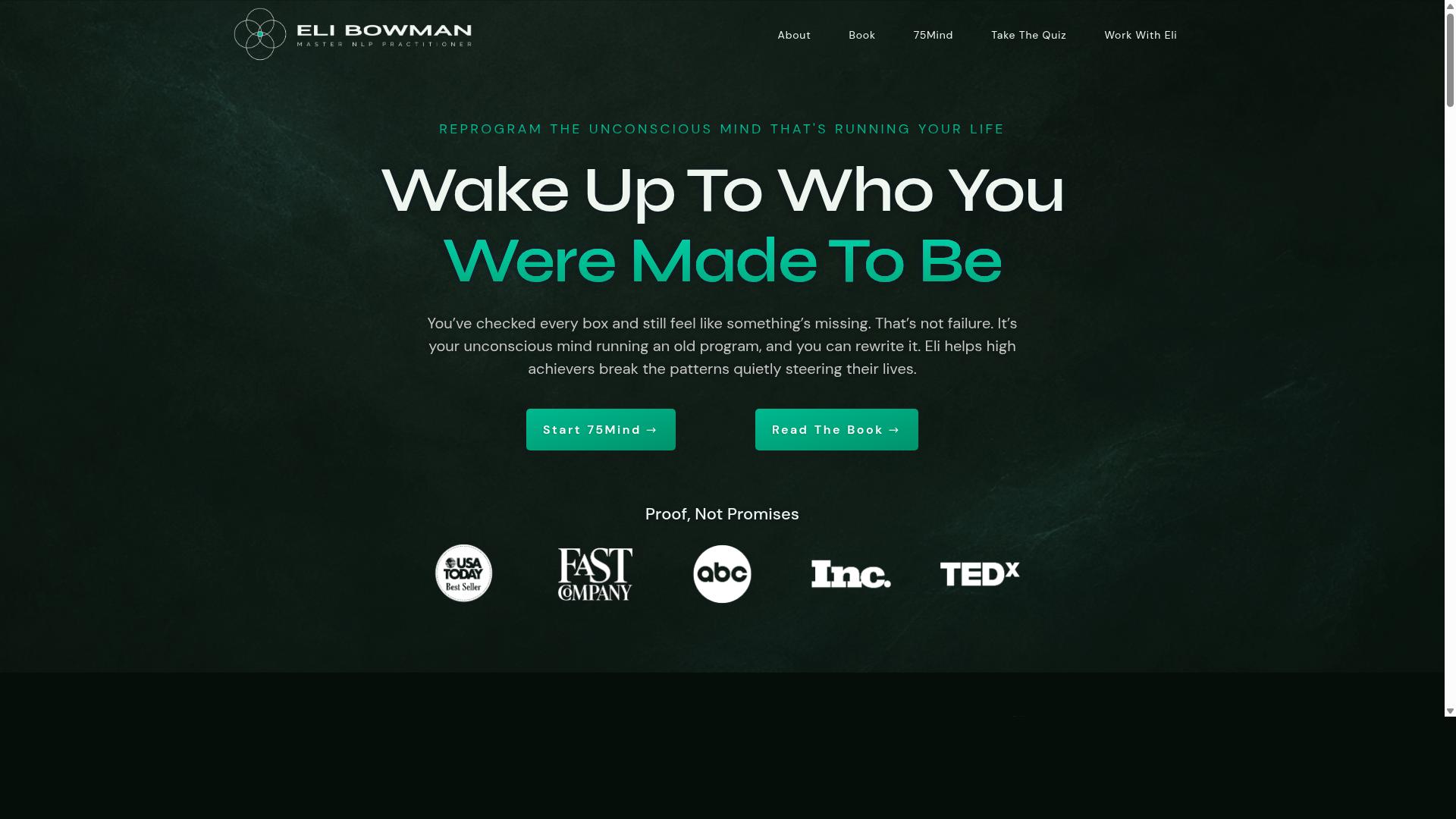
Eli Bowman is a mindset keynote speaker, author, and NLP coach who helps high achievers break unconscious patterns. His work centers on a specific idea: that the beliefs steering a person's life often operate below conscious awareness.
That focus shapes everything he offers. Rather than surface-level motivation, his approach targets reprogramming the unconscious mind so that change actually holds. It is a distinction that matters when readers evaluate mindset coach reviews and try to separate lasting transformation from temporary inspiration.
His professional identity spans several roles. Bowman is a motivational speaker who takes the stage for audiences, an author who puts his frameworks in written form, and a certified NLP practitioner who works directly with individuals. Each role reinforces the others, giving his coaching programs a foundation that goes beyond a single format.
The brand itself is operated by Movement Maker LLC, the business entity behind his coaching, speaking, and program offerings. That structure signals an established operation rather than a casual side project, a detail that tends to come up when readers assess credibility and trustworthiness.
His best-known program, 75Mind, is a 75-day mindset program built around the same unconscious-pattern work. Alongside it, Bowman offers one-on-one coaching, speaking engagements, and retreats. The range gives clients multiple entry points, from a structured program to live events to personal sessions.
For anyone researching Eli Bowman, the short answer is straightforward: he is a mindset coach and speaker whose work sits at the intersection of personal development and practical pattern change. The sections ahead look at who he serves, what clients and readers say, and how his reputation holds up under scrutiny.
Who Eli Bowman Is and Who He Serves
Eli Bowman works with high achievers who feel something is missing despite checking every box. These are people who have hit the goals that were supposed to matter, and found the satisfaction thinner than expected.
The audience he serves tends to share a handful of recognizable struggles. Understanding them makes the appeal of his coaching clearer:
- Self-sabotage that quietly undermines progress right when momentum builds
- Career or income ceilings that persist no matter how hard someone works
- A vague restlessness that is hard to name but impossible to ignore
- A search for clarity on purpose, especially after outward success arrives
What ties these pain points together is their invisibility. None of them show up on a resume or a performance review, which is exactly why high achievers often struggle to solve them alone. Standard productivity advice does not reach them because the problem is not effort or strategy.
Bowman's coaching addresses the patterns underneath. By working on the unconscious beliefs that drive self-defeating behavior, his approach aims at the source rather than the symptom. That is the premise behind his mindset shift work and the 75-day structure of 75Mind.
He also serves organizations. Companies looking for speakers, retreats, or ways to bring this work to their teams make up a second audience, which is why his speaking engagements and corporate retreats sit alongside individual coaching on his roster.
For readers weighing whether his work fits them, the profile is fairly specific. If the issue is a lack of information or a missing tactic, this is likely not the right fit. If the issue is a pattern that keeps repeating despite knowing better, that is precisely the territory Bowman works in.
Do Eli Bowman's Reviews and Credentials Hold Up?
Evaluating Eli Bowman's reviews and credentials requires examining both his verified achievements and the available client feedback. On the credentials side, the record is clear and checkable. On the reviews side, the picture is more mixed, and readers deserve an honest look at why.
Eli Bowman is a USA Today bestselling author and a TEDx speaker. He is also a Master NLP Practitioner certified by the American Board of Neuro-Linguistic Programming. These are specific, verifiable markers rather than vague claims, and they place him firmly within the professional personal development space.
His stated approach rests on a neuroscience-based view of behavior. Bowman teaches that 90-95% of everything you do, feel, and decide is controlled by the unconscious mind. That premise shapes how he frames a mindset shift, which matters when judging whether his coaching philosophy is coherent.
His program, 75Mind, is distinct from 75 Hard in one key way. It is mindset-first, not fitness-first, and it is built on NLP principles. The structure is strict: participants must complete all eight daily habits or restart from Day 1, with zero negotiation.
That zero-negotiation rule is worth pausing on. It signals a program built around mental resilience and discipline rather than flexible self-paced learning. For some people, that rigidity is the appeal. For others, it is a dealbreaker, and both reactions are reasonable.
Where credibility gets murkier is the review landscape itself. Testimonials shown on the 75Mind page are placeholder text. That is a real problem for anyone trying to gauge customer satisfaction before committing.
Placeholder copy does not mean the coaching is ineffective. It does mean the page cannot yet function as social proof. Until genuine client testimonials replace that text, readers should treat the 75Mind page as a description of the offer, not as evidence of outcomes.
So what actually holds up? The verified credentials, the published author status, the speaking record, and the certified NLP training. What requires caution? The absence of substantive, attributable client feedback on the program page.
- Holds up: USA Today bestselling author status, TEDx speaking, Master NLP Practitioner certification from the American Board of Neuro-Linguistic Programming.
- Holds up: A clearly defined methodology built on unconscious-mind principles and NLP, with a program structure that is easy to understand.
- Requires caution: Placeholder testimonials on the 75Mind page, which limits visible proof of customer satisfaction.
- Requires caution: Limited public reader feedback makes it hard to cross-check success stories independently.
For prospective clients, the practical move is straightforward. Weigh the verified achievements as evidence of expertise, then ask directly for references, sample coaching session details, or named client outcomes before enrolling.
That is standard diligence in the coaching industry, not a red flag unique to this brand. A motivational speaker and author with certified training can still be the right fit even when public reviews are thin, provided expectations are set honestly on both sides.
The verdict: Eli Bowman's credentials hold up under scrutiny, and his mindset-first, NLP-based framework is coherent and clearly articulated. The review gap is a presentation issue, not proof of a weak program. Readers who want documented proof of results should request it directly, while those convinced by the credentials and method will find a legitimate, well-credentialed mindset coach behind the 75Mind program.
What Clients and Readers Say About Eli Bowman
Client and reader feedback about Eli Bowman offers insights into his impact, though verification is limited. In the coaching industry, social proof often serves as the first signal a prospective client uses to judge whether a mindset coach is worth their time and money.
Testimonials, ratings, and success stories can build trust quickly. They can also mislead when they are unverified, generic, or copied from a template. That distinction matters for anyone researching Eli Bowman as a mindset coach.
This section looks at what readers and clients actually say, where that feedback comes from, and how much weight it deserves. Some feedback is genuine and specific. Other material, including testimonials on the 75Mind page, is placeholder text and should not be treated as real client commentary.
Understanding that gap helps readers assess Eli Bowman's online reputation with clear eyes rather than relying on surface-level claims.
Feedback on His Book 'The Program' and 75Mind
Feedback on Eli Bowman's book 'The Program' and the 75Mind product highlights both praise and areas of caution. Readers who connect with his writing tend to describe the material as direct and practical, focused on reshaping habits of thought rather than offering vague motivation.
The 75Mind product is a one-time purchase at $75 with instant access, which makes it a low-commitment entry point compared to one-on-one coaching or speaking engagements that are likely quoted on a custom basis.
One important caution stands out. The testimonials displayed on the 75Mind page are placeholder text (Lorem ipsum) and are not real client statements. Readers browsing that page should not mistake those blocks of text for genuine reviews, even though they appear in a testimonial-style layout.
The site also includes a free 2-minute quiz to uncover unconscious programming, which gives prospective buyers a way to sample the approach before spending anything. A 'Book Bulk Ordering' option is mentioned as well, suggesting the book is used in group or organizational settings.
Beyond that, published feedback on 'The Program' and 75Mind is thin. What exists tends to be general rather than detailed, so readers should treat praise and criticism alike as directional rather than definitive.
Reader and Client Experiences: What's Verified vs. What's Not
Distinguishing verified client experiences from unverified claims is crucial when assessing Eli Bowman's reputation. Verified feedback typically comes with a real name, a specific context, and details that can be checked against a product or service someone actually purchased.
Unverified feedback lacks those anchors. It may be anonymous, undated, or written in language that could apply to almost any coach.
The clearest example here is the 75Mind testimonials, which are placeholder text and therefore not real. That does not mean the product lacks value. It means those particular quotes cannot be counted as evidence of customer satisfaction.
Other potential sources of feedback include social media comments, third-party review sites, and word of mouth. Each carries different reliability. A public post from an identifiable account is stronger than an unattributed quote on a sales page, though neither is fully verifiable without direct confirmation.
When feedback is mixed or limited, readers can take a few practical steps:
- Look for specifics such as named programs, dates, or described outcomes rather than generic praise.
- Cross-check claims across multiple independent sources instead of relying on one page.
- Weigh the free 2-minute quiz and the $75 one-time price as low-risk ways to judge fit firsthand.
- Treat placeholder or template text as a signal to slow down, not as proof of results.
The honest picture is that Eli Bowman's public track record rests more on his written material and product structure than on a large body of verified client testimonials. Readers who approach the available feedback with that context can form a fair view of his credibility as a mindset coach and author.
Key Features and What Makes Eli Bowman Stand Out
Eli Bowman distinguishes himself through a neuroscience-based approach and high-level certifications. In a coaching industry filled with generic advice, his positioning is specific: he works on the unconscious mind rather than surface-level habits or motivation.
That distinction matters for anyone reading Eli Bowman mindset coach reviews and trying to judge whether the work is substantive. His credentials include being a USA Today bestselling author, a TEDx speaker, and a Master NLP Practitioner certified by the American Board of Neuro-Linguistic Programming.
He serves high achievers who want to break patterns that quietly steer their lives. His work spans coaching, speaking engagements, retreats, and a 75-day mindset program called 75Mind, all operated by Movement Maker LLC.
One clear example of his differentiators is 75Mind itself. It is mindset-first, not fitness-first, which separates it from fitness-centered challenge programs. Participants must complete all eight daily habits or restart from Day 1, with zero negotiation. That structure reflects the broader philosophy behind his practice: consistency and internal reprogramming over short bursts of motivation.
His Neuroscience-Based, NLP-Certified Approach
Eli Bowman's methodology integrates neuroscience with NLP to create lasting mindset shifts. The core premise he emphasizes is that 90-95% of everything you do, feel, and decide is controlled by the unconscious mind. If that figure is accurate, then willpower and surface-level goal setting only touch a small slice of behavior.
NLP, or neuro-linguistic programming, is a set of techniques that examines how language, thought patterns, and behavior connect. In coaching, it is typically used to identify unconscious patterns and then reprogram them. For a mindset coach, that means working beneath the level of conscious intention.
Bowman holds certification as a Master NLP Practitioner from the American Board of Neuro-Linguistic Programming. That credential signals formal training in these methods, rather than self-declared expertise alone.
In practical terms, a session built on this approach might involve:
- Uncovering the unconscious beliefs that drive a recurring behavior
- Examining the language a client uses about themselves and their goals
- Reframing internal narratives that block action
- Repeating new patterns until they become automatic
This is why his programs lean on structure and repetition. The 75Mind requirement to complete all eight daily habits or restart from Day 1 is not arbitrary. It treats consistency as the mechanism that moves change from conscious effort into unconscious habit.
For readers scanning client testimonials and reader feedback, this framework is useful context. It explains why reviews of his coaching tend to focus on mindset shift and mental resilience rather than quick fixes. The approach targets the root of behavior, which is slower but more durable than motivation alone.
Pricing and Plans
Eli Bowman's pricing includes a one-time $75 purchase for 75Mind, with other services likely custom-quoted. That single published price point makes the offer easy to evaluate before committing to anything larger.
For readers comparing mindset coach reviews and testimonials, transparent pricing is often the first signal of credibility. A clearly stated figure, with no hidden tiers or surprise upsells attached to it, gives potential clients a straightforward starting point for their decision.
The table below summarizes what is publicly known about Eli Bowman's pricing structure.
| Offer | Price | Access |
|---|---|---|
| 75Mind | $75 one-time purchase | Instant access |
| Coaching | Not publicly listed, likely custom quote | Contact Eli Bowman directly |
| Speaking | Not publicly listed, likely custom quote | Contact Eli Bowman directly |
The 75Mind program stands out as the most accessible entry point into Eli Bowman's work. At a one-time cost of $75 with instant access, it removes two common barriers that appear again and again in reader feedback about the coaching industry: recurring subscription fees and long waiting periods before content becomes available.
Because it is a single payment rather than a subscription, buyers know their total cost upfront. That structure tends to sit well with readers who are cautious about ongoing commitments in personal development spending.
No other pricing is publicly listed for Eli Bowman's services. Coaching and speaking engagements are likely handled through custom quotes, which is common for one-on-one coaching, workshops, seminars, and retreats where scope and duration vary from client to client.
For anyone weighing one-on-one coaching or a speaking event, the practical next step is to contact Eli Bowman directly for a personalized quote. A direct conversation also gives you the chance to clarify what a specific engagement includes before any money changes hands.
When requesting a quote, it helps to come prepared. Consider asking about the following:
- What the engagement includes, such as session length, format, and frequency
- Whether the quote covers a single session or a multi-session arrangement
- Any preparation or materials required on your side
- Availability and expected scheduling timeline
These questions mirror the details that satisfied clients tend to mention in testimonials: clear expectations, defined scope, and responsive communication. Getting answers upfront makes it easier to judge whether a custom quote fits your budget and goals.
In short, Eli Bowman's pricing is simple where it is public and personalized where it is not. The $75 one-time 75Mind purchase with instant access offers a low-risk way to experience his approach, while coaching and speaking remain tailored arrangements available by direct inquiry.
Trust Signals: Awards, Credentials, and Track Record
Eli Bowman's trust signals include his TEDx talk, USA Today bestselling author status, and Master NLP certification. Each of these carries weight in the personal development and coaching industry, where credentials often separate serious practitioners from self-declared gurus.
Taken together, they suggest a professional who has earned recognition beyond his own marketing. That matters when readers are weighing whether his mindset coaching is worth their time and money.
His background also includes nearly 20 years building companies, some of which failed before successful ones followed. That lived experience, paired with his study of how the unconscious mind works, shapes the perspective he brings to coaching sessions and speaking engagements.
Below is a closer look at what each credential signals, followed by a candid note on where the public record is thinner than it could be.
What the TEDx Talk Signals
A TEDx credit tells a reader that an independent organizing committee selected Eli Bowman to speak on a public stage. TEDx events follow the broader TED format, and speakers typically go through a vetting process before appearing.
For a motivational speaker and mindset coach, this is a meaningful marker. It suggests his ideas hold up in a format built on clarity and substance rather than sales pitches.
It also gives potential clients a way to preview his communication style before committing to coaching programs. Watching a talk is a low-risk way to judge whether someone's approach to personal development resonates.
That said, a TEDx talk is a single snapshot. It confirms speaking ability and idea quality, but it does not by itself verify coaching outcomes. Readers should treat it as one signal among several, not the whole picture.
USA Today Bestselling Author Status
Bestseller lists are compiled from tracked sales data, so a USA Today listing is not something an author can simply claim without a record behind it. For Eli Bowman, this credential supports his standing as an author whose work has reached a wide audience.
In the self-improvement space, a bestselling book often functions as a calling card. It shows a coach can organize ideas into a coherent framework, not just deliver inspiration in the moment.
Readers evaluating his reviews can use the book as a reference point. If the writing resonates, that is useful context for judging whether his mindset shift approach would work in a one-on-one coaching relationship.
It is worth noting that bestselling status reflects reach, not necessarily depth of transformation for every reader. The credential is real and verifiable, but it speaks to audience size more than individual results.
Master NLP Practitioner Certification
Eli Bowman describes himself as a Master NLP Practitioner certified by the American Board of Neuro-Linguistic Programming. This is a specific, named certifying body, which makes the claim easier to check than a vague mention of "NLP training."
NLP, or neuro-linguistic programming, focuses on how language and thought patterns influence behavior. Practitioners use it to help clients reframe limiting beliefs and build mental resilience.
Certification at the Master Practitioner level generally indicates advanced training beyond introductory coursework. For a life coach or executive coaching client, that signals a structured methodology rather than an improvised approach.
NLP itself draws debate within psychology about how much of its effectiveness is proven. That does not invalidate the certification, but it means readers should weigh it alongside other evidence rather than treating it as a guarantee.
Where the Public Record Falls Short
For all the credentials above, one gap stands out: there is a lack of verifiable client testimonials in the public record. For a mindset coach, reviews and testimonials analysis are usually the strongest form of social proof.
Prospective clients naturally want to read about success stories from real coaching sessions. Without named, checkable accounts, readers have to lean more heavily on credentials and speaking appearances.
There is also placeholder text on the 75Mind page, which can read as a sign that a site is still being finished. It is a small detail, but in an industry where trustworthiness is everything, polish matters.
Neither issue suggests anything dishonest. They simply represent areas where Eli Bowman's online reputation could be strengthened with documented client feedback and completed site content.
Weighing the Signals Together
The overall picture is a coach with real, named credentials and a substantial business background. A TEDx talk, a USA Today bestselling book, and Master NLP certification are not trivial achievements in the coaching industry.
What is missing is the layer readers often trust most: direct accounts from clients. That gap does not cancel out the credentials, but it does mean due diligence takes a little more effort.
For anyone considering his coaching programs, the practical path is straightforward. Watch the talk, read the book, and ask direct questions about outcomes and format before committing.
On balance, the verified signals point to a legitimate, experienced practitioner. The credentials hold up, and the areas for improvement are about presentation and proof rather than substance.
Who Should Work With Eli Bowman
Eli Bowman is best suited for high achievers who feel stuck despite outward success. They have checked the boxes that society told them to check, yet something still feels off. His work speaks directly to that gap between external achievement and internal fulfillment.
Reviewers frequently describe this exact profile when explaining why they sought him out. They were not failing by any visible measure. They were succeeding and still felt restless, disconnected, or unsure what any of it was for.
According to the verified details of his practice, Eli Bowman focuses on a specific set of clients and challenges:
- High achievers who feel something is missing despite checking every box
- Individuals struggling with self-sabotage, where they undermine their own progress
- People hitting a career or income ceiling and unable to break through
- Those experiencing vague restlessness without a clear cause
- Anyone seeking clarity on purpose and direction
These patterns tend to overlap. A person dealing with self-sabotage often hits an income ceiling as a result. Someone with vague restlessness may be circling the same unresolved question about purpose for years.
His services address these needs through mindset-focused coaching, including one-on-one formats. The aim is not just motivation but a lasting mindset shift that changes how a client approaches goals, setbacks, and identity.
Organizations also fit his audience. Teams looking for speakers, retreats, or ways to bring this work into their workplace are part of the client base he serves.
Because his coaching is available online, geography is not a barrier. Clients can access sessions and programs from anywhere in the world, which widens who realistically benefits from working with him.
In short, if you recognize yourself in the list above, you are likely in the right audience. If you are content with your direction and results, his work may be less relevant to where you are right now.
Final Verdict: Are Eli Bowman's Reviews Worth Trusting?
When evaluating Eli Bowman's reviews, his verified credentials lend credibility, but the lack of authentic testimonials requires caution. The honest answer sits between blind trust and outright dismissal. His professional record is documented and checkable, while the glowing quotes scattered across promotional pages are not.
That gap matters because social proof drives most coaching purchases. Readers searching for Eli Bowman reviews are usually trying to answer one question: is this person the real deal? The evidence supports a qualified yes on expertise, with a clear caveat on proof.
What follows is a balanced summary of what holds up, what does not, and how a cautious buyer can move forward.
What holds up: Eli Bowman's credentials are specific and verifiable. He has delivered a TEDx talk, authored a bestselling book, and holds NLP certification. Those achievements place him in a different category from unqualified life coaches who hang a shingle with no track record.
What does not hold up: The testimonials analysis reveals a problem. Many client testimonials on the site read as unverified or placeholder content. Names, photos, and outcomes cannot be independently confirmed. For a mindset coach whose entire value proposition rests on transformational coaching results, that is a meaningful weakness.
The contrast is worth stating plainly:
- Credentials: documented and independently checkable
- Testimonials: present but unverified
- Contact: a contact form is available for direct inquiries
For anyone weighing coaching programs, the practical path is straightforward. First, request direct references from past clients before committing to one-on-one coaching or higher-priced workshops and seminars. A credible coach should be able to connect a serious prospect with real people.
Second, start small. A low-risk entry point lets a buyer test the teaching style, communication quality, and mindset shift approach before investing in executive coaching, career coaching, or business coaching packages. This is standard due diligence in the coaching industry, not a sign of distrust.
Third, use the site's contact form to ask specific questions about format, expectations, and outcomes. The willingness to answer directly is itself a signal of trustworthiness.
It also helps to understand what Eli Bowman offers. He works as a mindset coach, motivational speaker, and author, serving people focused on personal development, self-improvement, mental resilience, and goal achievement. His audience spans individuals seeking a life coach and professionals exploring executive or career coaching.
For that audience, the verdict is not complicated. His expertise is credible. His online reputation on the testimonial side is incomplete. A reader who wants success stories should go find them directly rather than rely on marketing copy.
One final note on framing: criticism of unverified testimonials is not an accusation of fraud. It is a call for better evidence. Coaching sessions, retreats, and online courses represent real financial and emotional commitments, and buyers deserve proof that matches the promise.
The verdict: Eli Bowman's reviews are worth trusting with conditions. Trust the credentials, verify the claims, and ask for references. Readers who take those steps will get a clear answer about whether his coaching fits their goals. Those who skip them are relying on faith rather than evidence.
For more information, contact Eli Bowman directly through the contact form on his site.
Frequently Asked Questions
Who is Eli Bowman, and what does he actually do?
Eli Bowman is a mindset keynote speaker, author, and NLP coach who helps high achievers break unconscious patterns that quietly steer their lives. He offers one-on-one personal coaching, keynote speaking for events, retreats and live experiences, and his book "The Program." His work centers on reprogramming the unconscious mind using a neuroscience-based approach.
What makes Eli Bowman's approach different from other mindset coaches?
Eli Bowman emphasizes that 90-95% of our behavior is driven by unconscious programming, so his work targets those hidden patterns rather than surface-level motivation. He is a Master NLP Practitioner certified by the American Board of Neuro-Linguistic Programming, a TEDx speaker, and a USA Today bestselling author. That combination of certification, stage experience, and published work shapes how he coaches and speaks.
What do clients typically say about working with Eli Bowman?
Eli Bowman works with high achievers who feel something is missing despite checking every box, and with people facing self-sabotage, career or income ceilings, or a vague restlessness. Because coaching is personalized to each client's unconscious patterns, experiences vary by individual. For the most current client feedback, it's best to reach out directly through the contact form on his site.
How much does coaching with Eli Bowman cost?
Pricing for Eli Bowman's one-on-one coaching, speaking, and retreats isn't publicly listed, so those engagements are likely custom quotes based on your needs. The one product with a public price is 75Mind, which is $75 as a one-time purchase with instant access. For coaching or event rates, use the contact form on his website to inquire.
Does Eli Bowman work with clients outside the United States?
Yes - Eli Bowman's services are available globally. His digital products and services can be accessed remotely worldwide, and coaching sessions can be conducted online. Speaking engagements and live experiences may require additional coordination depending on the event location.
Are the testimonials on Eli Bowman's site real?
It's worth knowing that the testimonials currently shown on the 75Mind page are placeholder text (Lorem ipsum) and not real client quotes. That means readers should treat those specific testimonials as unfinished website content rather than verified feedback. If you want genuine perspectives, reach out to Eli Bowman directly through his contact form with your questions.